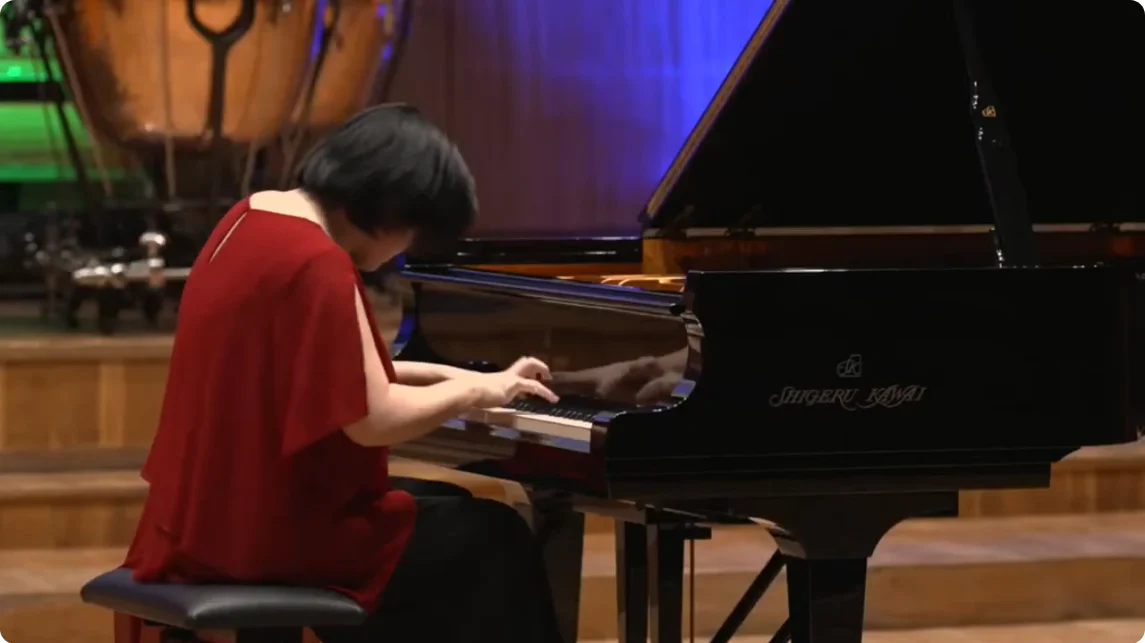

On Tuesday, the semifinals of the 13th Ignacy Jan Paderewski International Piano Competition began in Bydgoszcz. Ten talented musicians remain, with Japan being the strongest represented—three of its participants have advanced to this stage. Many consider the Paderewski Competition to be the second largest after the Warsaw-based Fryderyk Chopin Competition. The honorary director of the competition, Henryk Martenka, emphasizes that the two competitions cannot be directly compared.
“The two competitions do not exclude each other, because the Chopin Competition is monographic—you perform only Chopin’s works there. Paderewski is the second-largest piano competition with an interdisciplinary program. Here you perform the entire piano repertoire, from Baroque to contemporary music. So the competitions complement each other perfectly. Not every pianist has to be a Chopin specialist,” Henryk Martenka explains in our conversation.
During the semifinals, which take place on Tuesday and Wednesday, each participant performs twice, including once with the orchestra. Late Wednesday evening, we will learn the names of the five finalists.
“It will be difficult to predict who will take which place. Here, fractions of points make the difference, and the final fourth stage with the orchestra is crucial. Anything can happen at that stage,” Martenka notes.
On Tuesday, the Pomeranian Philharmonic also hosted the opening of an art exhibition showcasing how music can be represented through visual arts. This event accompanies the piano competition. This year’s art contest refers to the works of Bydgoszcz-born composer Mieczysław Karłowicz.
The imagination may also be stirred by the figure of the competition’s patron, Ignacy Jan Paderewski, who is said to have spent only 30 minutes in Bydgoszcz in 1918—at the train station, waiting for his train to be prepared. Debates continue over whether Paderewski should be associated with Bydgoszcz or not.
“It is a phenomenon in which Paderewski’s legend in Bydgoszcz was created by Andrzej Szwalbe,” explains Henryk Martenka, who is among those strongly identifying the maestro with the city on the Brda River.
“For many years, Ignacy Jan’s half-brother, Józef Paderewski, lived here. A teacher at a local secondary school, he is buried here and was held in very high esteem. He was shown gratitude for his famous brother, particularly because Bydgoszcz was incorporated into the Republic of Poland as a result of the Treaty of Versailles.”
It is worth recalling that the Treaty of Versailles was signed on behalf of Poland by Ignacy Jan Paderewski and Roman Dmowski. Thanks to Szwalbe, the Pomeranian Philharmonic has been under Paderewski’s patronage from the very beginning; later, the piano competition was inaugurated, and the Bydgoszcz airport was also named after him.
“I believe that for a vast number of people around the world, Bydgoszcz has become firmly associated with Paderewski.”
Among the 10 semifinalists, there is also one Polish participant—Michał Oleszak.