Combating disinformation is now one of the key challenges facing Poland, not only because of the growing importance of the internet, but also because of the country’s geopolitical position on the front line. The scale of fake news spreading rapidly online is enormous and continues to grow. But how can a state and a democratic society defend themselves against this threat?
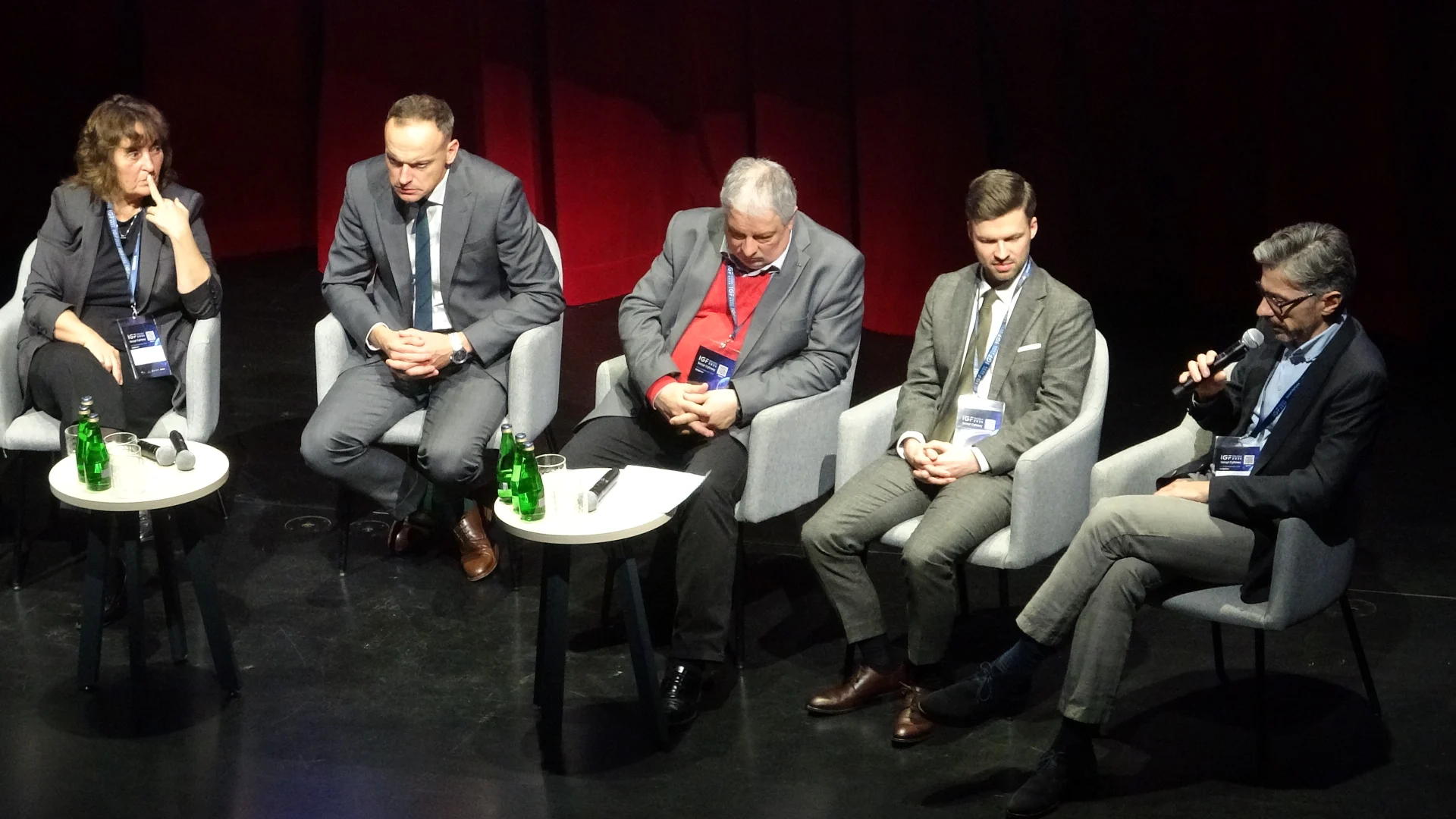
This was the main topic of one of the panels held on the second day of the IGF Poland Digital Summit, which took place at the Academy of Music in Bydgoszcz. However, the discussion did not produce any “miracle” solutions to the problem. According to Paweł Sokołowski of SAS Institute, statistics and mathematics could prove to be powerful tools. By applying probability theory, algorithms could learn to expose falsehoods.
“We should build our own knowledge bases by collecting this information. This would allow us to analyse trends and even predict certain developments,” he said during the panel discussion.
According to Patryk Zakrzewski of Demagog.org.pl, the issue is becoming more complicated because there are different types of disinformation, and each will most likely require a different remedy. The problem cannot be solved with a one-size-fits-all approach.
“We are not talking about disinformation, but about different forms of disinformation,” Zakrzewski stressed, describing it as a multilayered problem.
“I agree that there is an elephant in the room in the form of Russian and Belarusian influence, which we have to address somehow. But on the other hand, we have an entire menagerie of other threats. These include charlatans trying to introduce medical disinformation into public discourse, those attempting to undermine the scientific consensus on climate change, and, finally, the significant amount of external disinformation coming from our own representatives in the Sejm and Senate, as well as from political groups seeking election to those bodies.”
Zakrzewski believes that separate solutions should be developed for medical disinformation, climate disinformation and disinformation originating in Russia.
The expert also acknowledges that sceptical voices should be given a hearing, including those questioning the democratic system or Poland’s membership in the European Union.
“I am convinced that these voices are not being heard sufficiently today, and people are looking for answers in places where those answers are not based on sources, facts or statistics. It seems to me that we lack a public debate in which these doubts can be brought into the open.”
Elżbieta Żak of the Office of Electronic Communications (UKE) joined the discussion remotely. She pointed out that Poland has been relatively slow to implement European directives, partly because they have faced significant resistance. In her view, this opposition was fuelled by disinformation about the directives, including claims that they would introduce censorship.
A special council is set to be established under the President of the Office of Electronic Communications. Żak invited experts to join the initiative and work together to develop solutions.
Od 2009 roku związany z lokalnymi mediami. Specjalizuje się w tematach dotyczących infrastruktury, polityki regionalnej oraz funkcjonowaniu samorządów.