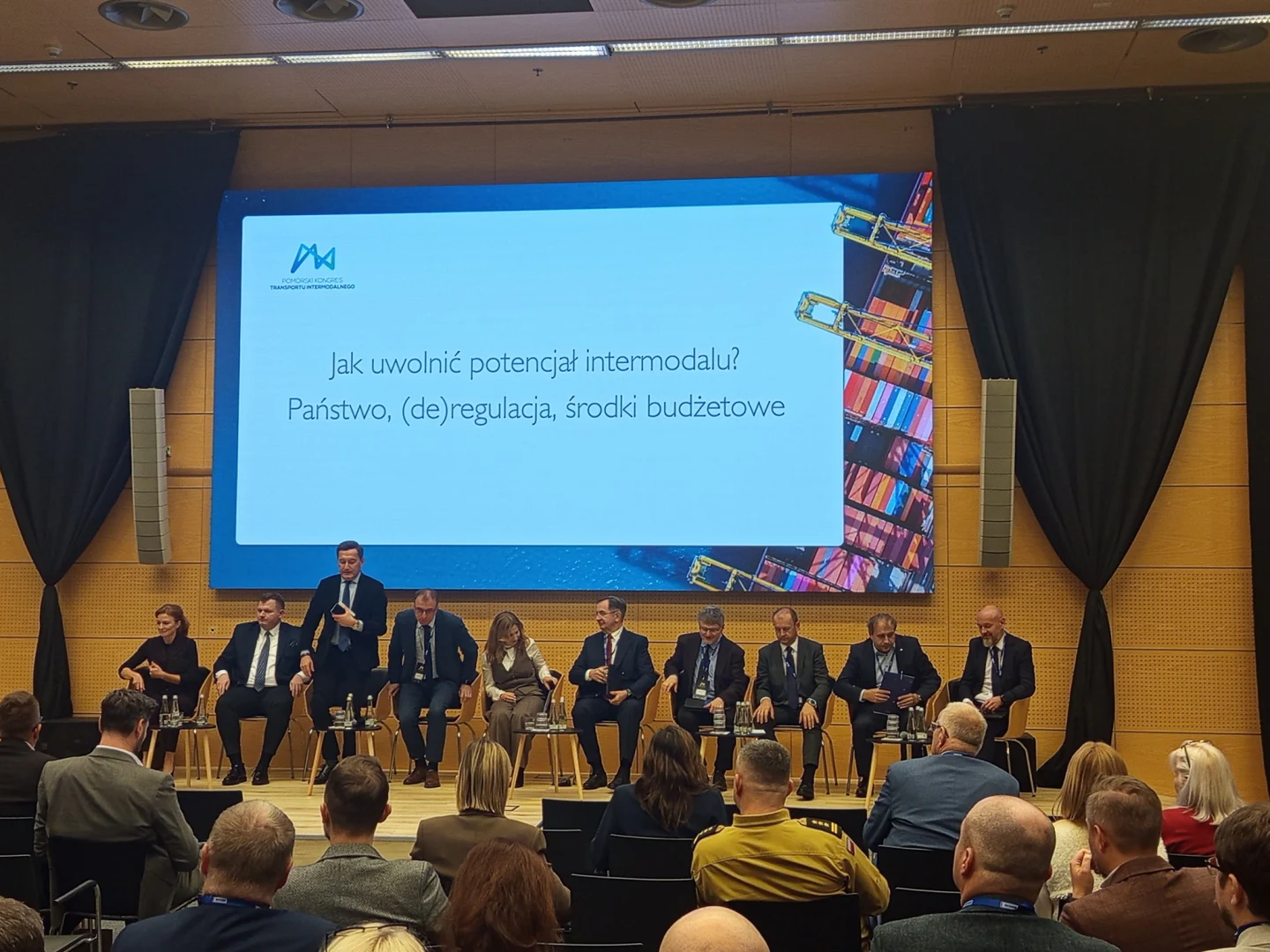
Polish railways are breaking records in passenger transport, but in recent years freight transport has been declining, which has led to serious problems for PKP Cargo. In late July, railway workers across Poland protested against this situation. The causes and future of rail freight transport were discussed in Gdańsk during the 4th Pomeranian Congress of Intermodal Transport.
The main reason for the drop in freight volumes – 223.5 million tons transported in 2024, compared to 231.6 million tons in 2023 and 248.5 million tons in 2022, with monthly figures this year consistently lower than the previous year – is the accelerated transition of the Polish economy away from coal. Additionally, the slowdown in the German economy has had a smaller but noticeable impact.
“We’re seeing a massive drop in transport capacity. The year 2023 showed that everything started to fall apart,” said Paweł Pucek from the board of DB Cargo during the debate. He pointed out that intermodal transport, i.e. container shipping, is the one area showing growth: “This shows that when coal declines, intermodal rises. That’s the positive exception.”

However, the increase in intermodal freight volume is not yet sufficient to offset the decline in coal and other bulk goods. According to Artur Warsocki, a board member of PKP Cargo, it could be possible within the next few years:
“In 4–5 years, intermodal transport might fill the coal gap.”
Warsocki believes that a key limitation to the rapid development of intermodal transport lies in infrastructure deficiencies:
“Is there currently any entity capable of building a genuine network of container terminals in Poland?”
This rhetorical question highlights the core challenge faced by initiatives such as the planned terminal in Emilianowo near Bydgoszcz. Prof. Stefan Akira Jarecki from the Warsaw University of Technology noted:
“Terminals are unevenly distributed – in 3 out of 16 voivodeships, there are none at all.”
Prof. Jarecki is one of the co-authors of the “Goods on Rails” report by the Pro Kolej Foundation, which drew attention some time ago in the Kuyavian-Pomeranian region for showing that this voivodeship remains a blank spot on Poland’s terminal map.
The debate at the congress focused on finding solutions that would both facilitate the growth of intermodal transport and make rail more competitive compared to road transport. A frequently raised issue was that rail access charges are incomparably higher than those for road transport. MP Stanisław Lamczyk announced the establishment of a parliamentary subcommittee on intermodal transport, which will aim to address and remove these development barriers.